For a long time, Indian cinema existed inside a language of anticipation. We spoke of it as an industry perpetually “on the brink”, of global recognition, of serious critical legitimacy, of finally being understood beyond stereotypes. Every festival screening was framed as a breakthrough, every foreign review treated as a moment of validation. 2025 quietly dismantled that waiting-room narrative. This was not a year of arrival announcements or chest-thumping milestones. It was the year Indian cinema simply occupied space, steadily, confidently, and without explanation.
What changed most noticeably was posture. Indian films in 2025 did not travel with footnotes. They did not explain their politics, translate their emotional grammar, or dilute their cultural specificity to feel accessible. They trusted audiences to meet them where they were. That trust showed up most clearly on the global festival circuit. Indian presence this year was not limited to the number of films screened, but extended into positions of influence and permanence. When Payal Kapadia sat on the Cannes jury, it mattered not because of visibility alone, but because it signalled a comfort with Indian filmmakers as arbiters of cinematic taste, not merely participants seeking approval.
Advertisement
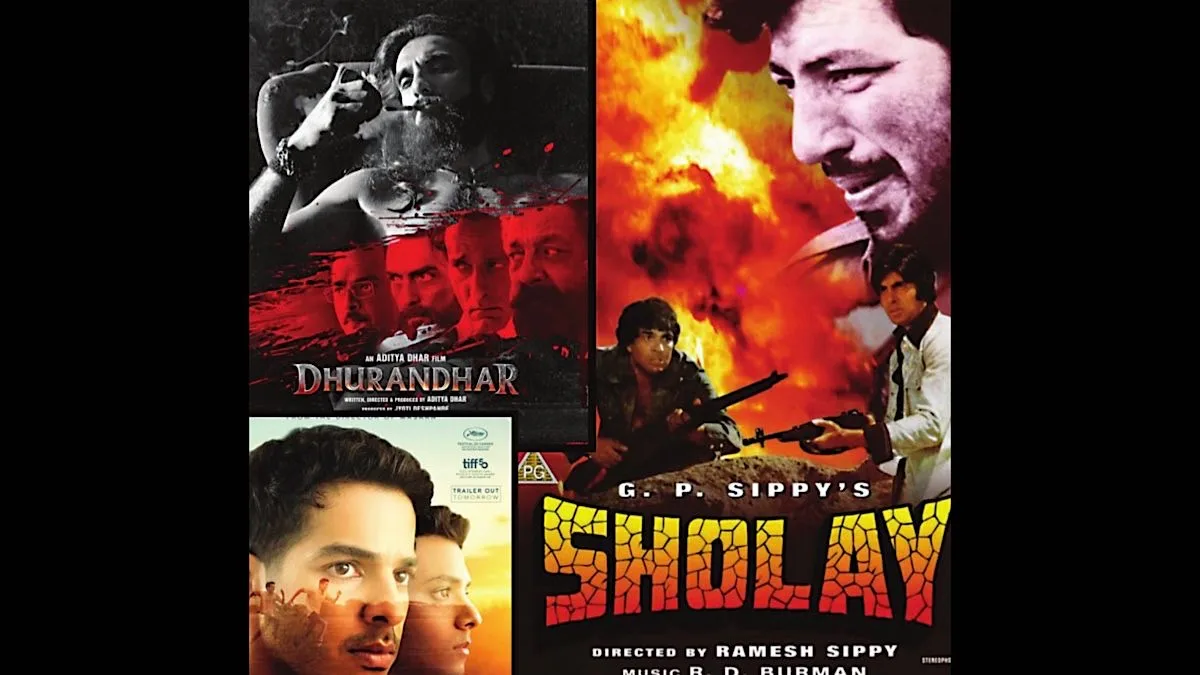
Equally telling was the way Indian cinema’s past was treated alongside its present. The international showcasing of restored Indian classics, including Sholay, was not nostalgia packaged for applause. Restoration is canon-making. It is a statement that a film belongs to world cinema’s long memory, not just to national sentiment. When such films are restored, screened, and discussed in global spaces, they are no longer curios from another industry; they become reference points. In 2025, Indian cinema was doing two things at once, producing new work and securing its archival legitimacy.
The contemporary films that travelled this year reflected a similar confidence. Neeraj Ghaywan’s Homebound, which circulated prominently on the international circuit and later became India’s official Oscars submission, did not announce itself as a “social film” or an export-ready morality tale. It was restrained, intimate, and unafraid of quietness, qualities that would once have been considered risky for an Indian film abroad. That it was received on its own terms signalled a shift in how Indian storytelling is read globally. Indian cinema no longer needed to be loud to be heard.
This broadening of India’s cinematic identity was visible elsewhere too. The Indian presence at TIFF’s landmark 50th edition spanned new political cinema, auteur-driven work, and restorations, offering not a single narrative but a portfolio. At Venice, Anupama Roy’s Best Director win in the Orizzonti section carried a different weight altogether. These were not isolated triumphs; they suggested repeatable pathways into the global ecosystem. Indian cinema in 2025 did not feel like a guest appearance. It felt embedded.
Back home, the relationship between audiences and the big screen continued to evolve in telling ways. Theatrical cinema did not fade in 2025, but it became more intentional. Going to the movies increasingly felt like an event rather than a habit. This was visible at both ends of the spectrum, from the reverent reception to restored classics to the appetite for unapologetically large, star-driven spectacles. Films like Dhurandhar, positioned squarely as a big-screen experience, reaffirmed why theatres still matter. In an era where almost everything eventually finds its way to streaming, such films reminded audiences that scale, sound, and collective energy cannot be replicated on personal devices. The cinema hall is no longer competing with streaming platforms on volume. It is competing on experience, and in 2025, it leaned into that distinction with renewed clarity.
Everything else, mid-budget dramas, intimate character studies, experimental narratives, found a more natural home elsewhere. This was not a failure of theatres, but an evolution of format logic. The big screen reclaimed its role as a cultural occasion rather than a weekly default. In doing so, it regained a certain dignity.
Streaming, meanwhile, went through a far more unsentimental reckoning. If earlier years were marked by expansion and optimism, 2025 was defined by consolidation and realism. The merger of JioCinema and Disney+Hotstar into JioHotstar fundamentally reshaped India’s OTT power structure. Combined with cricket’s gravitational pull, especially the IPL, it signalled a move away from growth-at-all-costs towards control, monetisation, and scale. The shift from free streaming to hybrid access models made one thing clear: platforms were no longer chasing eyeballs alone, but sustainable revenue.
Advertising, once treated as a necessary evil for premium platforms, returned unapologetically to the centre. Prime Video’s decision to introduce limited ads in India, with an optional paid upgrade for ad-free viewing, reflected a broader industry acknowledgement. Subscription fatigue is real. Disposable incomes are finite. Attention is fractured. Ad-supported tiers are no longer a compromise; they are infrastructure. Streaming in 2025 stopped pretending it could exist in a financial vacuum.
Telecom-led bundling became another quiet but telling shift. Aggregated OTT packs weren’t just about convenience; they reflected changing viewer psychology. Indian audiences are pragmatic. They want value, simplicity, and flexibility. Platforms that recognised this behavioural truth adapted. Those that didn’t struggled to justify their price tags. At the same time, Netflix doubled down on India not merely as a consumer market, but as a production hub, investing in diverse stories across formats, genres, and languages rather than chasing a single viral hit.
What stood out was how OTT platforms finally began behaving as if India is not one audience, but many. Sports continued to anchor mass engagement, but scripted content diversified in quieter, more confident ways. Regional stories, genre experiments, and long-form narratives were allowed to breathe. The obsession with finding “the next big thing” gave way to building libraries that reflect the country’s contradictions.
Perhaps most importantly, the adversarial framing of cinema versus streaming began to dissolve. Festivals fed prestige into theatres, theatres fed visibility into streaming, and streaming fed risk-taking back into cinema. The question was no longer where a film should exist, but where it made the most sense. Format became a creative decision, not a hierarchy.
Taken together, the shifts across celluloid and OTT point to a larger truth. Indian cinema is no longer negotiating its place in a global order designed elsewhere. It is participating in shaping that order. It has learnt that influence comes not from imitation, but from confidence in its own storytelling grammar. It has also learnt that technology does not replace culture, it tests it, monetises it, stretches it, and occasionally forces it to grow up.
2025 may not be remembered for one defining film or a single dramatic moment. It will be remembered as a year of quiet consolidation, of voice, presence, and intent. A year when Indian cinema stopped asking what the world wanted from it, and started showing the world who it already was. And in a crowded global cultural landscape, that kind of self-assured clarity may be the most powerful statement of all.
(The writer is a Former Civil Servant, who writes on Cinema and Strategic Communication. Views are personal.)
(Inputs provided by Zoya Ahmad and Vaishnavie Srinivasan)